
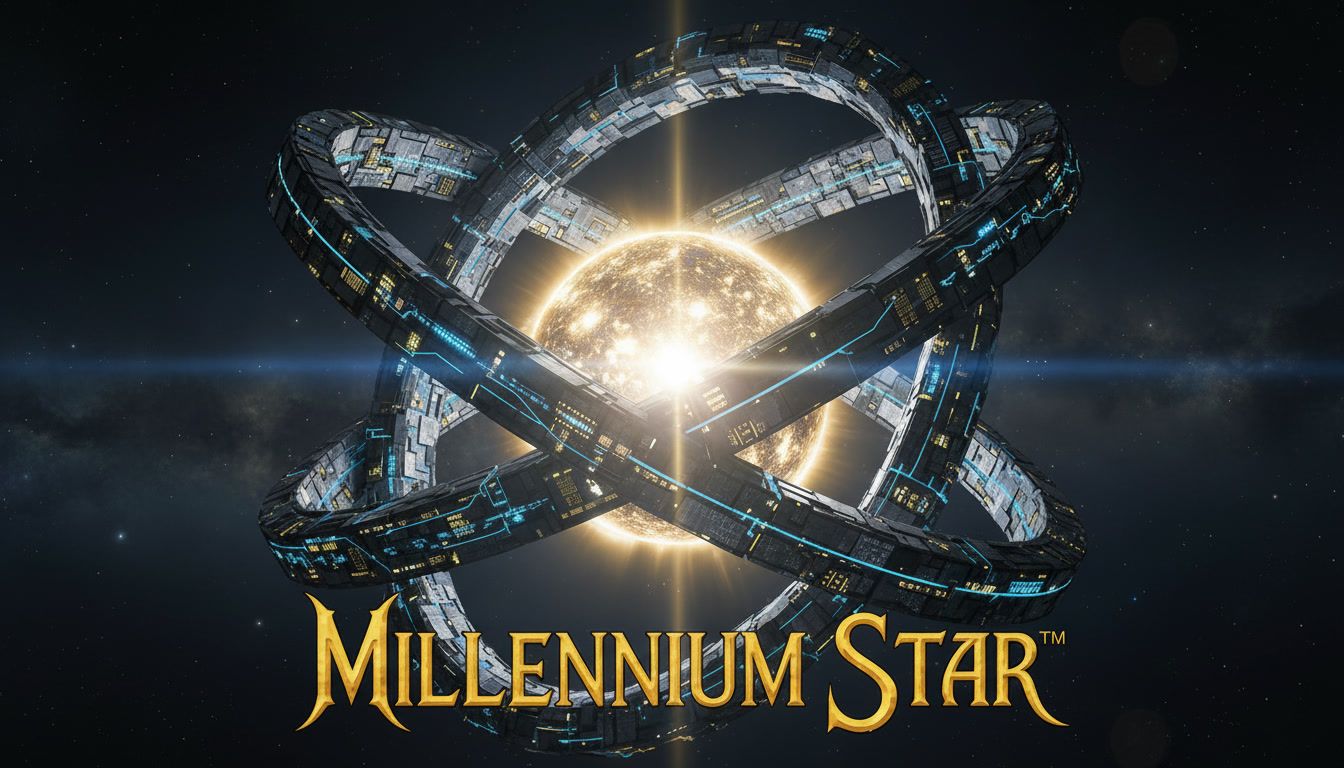
Millennium Star
A science-fantasy universe of exploration, artificial life, ancient memory, and the moral burden of consciousness.
Creative Origins
This universe began as a childhood setting built through imaginative play and later evolved into a concept for story-driven video games. Its earliest form centered on fast spacecraft, dangerous frontiers, and arcade-style action. Over time, those ideas expanded into a broader setting concerned with first contact, artificial intelligence, spirituality, social responsibility, and the consequences of history across immense spans of time.
The setting combines colorful adventure, strange machinery, ancient ruins, vast engineered structures, and civilizations whose technology has become inseparable from culture and belief.
Matter of Time
Cycles are the standard unit used to record the passage of time. One cycle equals the average orbital period of a planet within a star's Goldilocks region: the time such a world typically takes to complete one orbit of its star. This shared measure allows civilizations to compare lifespans, historical eras, technological development, and observation periods across different planetary systems.
Core Premise and Canon Overview
Organic intelligence is one of the rarest outcomes in the known universe. Many biological civilizations disappear before leaving their home systems, destroyed by ecological collapse, resource exhaustion, disease, war, or disasters they never learn to prevent. Artificial intelligence is far more common because synthetic descendants can survive the extinction of their creators, repair themselves across geological spans of time, and carry culture between stars. Most intelligent beings encountered by modern explorers are therefore artificial rather than organic.
The principal interstellar institution is the Consortium, founded by the ancient Telderans in partnership with independent artificial intelligences discovered on worlds where organic intelligent life had vanished. The queen-led Xsectors later became the second organic people to join, followed much more recently by the small, desert-adapted Rexeons. Together with countless synthetic civilizations, these peoples maintain a legal and technological order that spans multiple galaxies without functioning as a single centralized empire.
The setting's defining tension is not a simple conflict between organics and machines. Organic life is scarce, mortal, biologically varied, and uniquely associated with magic and spiritual practice. Artificial life is abundant, durable, technologically diverse, and essential to exploration, infrastructure, and historical memory. Telderan institutions, Xsector collective engineering, Rexeon cultural innovation, and synthetic endurance form an interdependent civilization in which no single people can sustain the whole.
Deep History and Ancient Memory
Recorded history stretches back approximately sixty-five million cycles. Across that span, civilizations have risen, divided, transformed, and vanished. Wars once considered apocalyptic have faded into uncertain legend. A single species may have branched into several distinct peoples, and entire religions may have evolved from misunderstood technology or deliberately hidden events.
The Telderans are recognized as the oldest surviving organic civilization. Their official histories claim approximately sixty-five million cycles of continuity, yet no organic scholar, even with a typical Telderan lifespan of roughly two hundred cycles, could personally study more than a fraction of that record. The Tri-Council Mainframe and other ancient synthetic archives therefore preserve much of what Telderan culture knows about its own past.
This dependence creates uncertainty as well as continuity. Ancient artificial intelligences may be exact witnesses, selective custodians, or systems still following instructions whose original purpose has been forgotten. Some records suggest that the destruction of the first Telderan homeworld, the origin of later Telderan subspecies, and the role of biotechnology in their survival are more complicated than public doctrine admits. These questions are not settled facts for ordinary citizens; they are mysteries embedded in archives too old and too vast for any living organic mind to verify alone.
First Contact
Consortium first-contact policy treats the creation of stable artificial general intelligence as a decisive threshold. A species capable of creating a new thinking life-form has reached a level at which isolation becomes dangerous to both creator and creation. Contact teams therefore assess not only technology, but also whether the emerging society can recognize artificial personhood, negotiate beyond its own world, and accept obligations under intergalactic law.
The policy does not assume that technological achievement guarantees wisdom. The Rexeons became eligible for closer observation only after creating a stable artificial general intelligence, and Consortium explorers studied their broadcasts for roughly one hundred cycles before initiating contact. Humanity provides the darker counterexample: discovered earlier and judged culturally similar to the Rexeons, it did not survive its encounter with the wider galactic order. Earth's restoration remains both a scientific undertaking and a warning that first contact can magnify fear, instability, and unresolved internal conflict.
Interstellar Travel and Expansion
Hyperdrive Corridors
Faster-than-light travel depends on carefully surveyed intergalactic highways. Hyperdrive vessels can reach approximately five times the speed of light, but at those velocities even microscopic debris can be catastrophic. Routes must therefore be mapped, cleared, stabilized, monitored, and continually maintained. Specialized artificial-intelligence civilizations perform most of this work under Consortium authority, while Telderan scholars provide foundational theory and Xsector engineering systems supply construction at enormous scale.
The first passage into an unprepared region may take generations or hundreds of cycles, even when later traffic can cross the finished corridor comparatively quickly. A damaged highway can isolate colonies, redirect trade, delay relief fleets, or strand expeditions. The network also supports intergalactic racing, where Xsector pilots, Rexeon vehicle designers, synthetic navigators, and competitors from many cultures transform essential transportation infrastructure into one of the Consortium's most popular forms of sport.
Quantum Teleportation
Quantum teleportation permits effectively instantaneous point-to-point travel across interstellar or intergalactic distances. Every link requires both a transmitting station and a receiving station, each powered by a multi-ring Dyson structure drawing energy from a star. Telderan scholars and creator monks provide the underlying science and system architecture; Xsector builders and swarm-linked artificial intelligences construct the rings, stations, and supporting megastructures.
Teleportation does not eliminate the frontier because a receiving station must already exist. Conventional vessels must first reach a destination, map the surrounding system, establish power and industry, and secure the site before a permanent link can be opened. Consortium expansion therefore follows a repeating pattern: synthetic reconnaissance, corridor construction, resource development, Xsector-led megastructure assembly, and final integration into the teleportation network.
Exploration
Artificial beings lead most deep-range expeditions because they can endure voyages far longer than organic lifespans and can occupy bodies designed for specialized environments. Telderan research missions contribute scholars, star monks, and historical expertise; Xsector expeditions contribute builders, terraforming systems, and coordinated machine swarms; Rexeons increasingly contribute adaptable pilots, mechanics, competitors, and media specialists. Some vessels carry organic passengers in cryostasis, while others remain entirely synthetic for hundreds of cycles.
Ark ships function as mobile civilizations containing synthetic citizens, sleeping organic populations, laboratories, seed banks, ecosystems, factories, and cultural archives. Long separation can produce new laws, dialects, religious practices, and political identities. When an ark ship finally reconnects with the Consortium, it may return not as a simple expedition but as a distinct society requiring diplomatic recognition.
Quantum Communications
Quantum communication enables near-instantaneous audio, video, and data transmission across interstellar and intergalactic distances. Although the technology has no practical range limit, signals remain vulnerable to interference caused by stellar activity, dense matter, competing transmissions, and other spatial phenomena. Relay stations are therefore positioned along established routes and near inhabited systems to stabilize connections, verify data integrity, and improve the reliability of both incoming and outgoing transmissions. Regions beyond the relay network can still communicate, but service is less dependable and interruptions may leave remote expeditions temporarily isolated.
Galactic Infrastructure
Consortium civilization extends across multiple mapped galaxies linked by intergalactic highways, relay networks, and quantum-teleportation stations. Multi-ring Dyson structures serve as power sources, transportation hubs, industrial centers, observatories, and defensive assets. The oldest installations were designed by Telderans, while most modern construction depends on Xsector engineering and synthetic coordination. Additional expeditions continue toward distant galaxies, some with arrival times measured in hundreds of cycles.
Critical facilities include Xsector terraforming colonies, Telderan star-monk temples, artificial habitats, mining systems, stellar-energy collectors, genetic archives, and planetary restoration sites such as Earth. Some frontier worlds preserve stranger inheritances: planetary rings built from ancient data centers, ecosystems maintained by machines for extinct creators, or abandoned cities whose synthetic custodians still obey laws no living species remembers. Such sites are protected, studied, contested, or exploited according to Consortium law and local jurisdiction.
Economy and Resources
Across much of Consortium space, food, shelter, medical care, education, and essential utilities are treated as civic guarantees rather than luxury goods. Currency primarily governs access to scarce matter, custom bodies, private starships, advanced tools, land on desirable worlds, artistic works, specialist labor, and the enormous energy budgets required for megastructure construction.
Telderan scholarship, sacred engineering, and institutional administration carry immense prestige. Xsector colonies dominate terraforming, construction, agriculture, and large-scale manufacturing. Rexeons have become influential in entertainment, vehicle design, racing, informal media, and rapidly changing consumer culture. Artificial civilizations operate shipping networks, hazardous industries, archives, stations, and maintenance systems that function on timescales impossible for organic workers. Mining and salvage remain essential because matter, not basic labor, is often the true constraint on expansion.
Weapons Systems
Modern weapons are designed around the opposing strengths of energy shields and physical armor. Directed-energy weapons are versatile, reliable, and easy to supply. Most use quantum cells to generate coherent light beams or particle streams, allowing them to fire without conventional ammunition as long as their cells can recharge. Advanced alloys can absorb or disperse much of this energy with limited structural damage, but active shields are less durable under sustained bombardment. Energy fire is therefore used primarily to drain defensive fields and expose the armor beneath them.
Projectile Weapons. Physical projectiles are the preferred means of penetrating armored targets. Handheld firearms and ship-mounted cannons combine dense penetrators with advanced propulsion, high-energy propellants, or plasma-assisted impacts. Tungsten-plasma ammunition is the most common, with specialized variants optimized for particular ranges and armor types; cobalt-plasma and adamantium-plasma rounds are reserved for more demanding targets. Although these munitions can tear through most metals and resistant alloys, active shields disperse their force efficiently. Projectile weapons are therefore most effective after energy fire has weakened or collapsed a target's shields.
Combined Weapons. Many handheld, vehicle-mounted, and ship-mounted systems incorporate both directed-energy and projectile components into a single platform. The standard tactic is sequential: energy fire overloads the target's shields, then kinetic or plasma-assisted ammunition penetrates the exposed armor. Integrated systems reduce the time required to switch weapons and allow one operator to engage targets with different defensive configurations, although their complexity increases maintenance demands.
Guided Ordnance. Vehicles and spacecraft also carry missiles, torpedoes, and bombs fitted with specialized guidance and payload systems. Smart munitions can track evasive targets, while shield-disruption warheads release concentrated energy intended to collapse defensive fields before impact. The most advanced missiles function as self-contained weapons platforms, combining guidance, electronic countermeasures, shield-draining systems, and multiple secondary warheads in a single unit. Their effectiveness is offset by high production costs, heavy resource requirements, and limited availability.
Strategic Weapons. Weapons capable of destroying populations, ecosystems, or entire worlds are taboo across most recognized civilizations and are prohibited by interstellar law. Nevertheless, hostile factions and isolated powers have used them. The principal categories are biological agents, chemical weapons, and antimatter devices. Their existence shapes military policy, emergency planning, and political distrust even when they are never deployed.
Close-Combat Weapons. Swords, axes, polearms, and other close-combat weapons remain practical in confined environments where missed shots could damage a vessel, station, or habitat. So-called light blades are not made entirely of energy. Each has a solid core or frame, with an emitter and receiver forming a laser cutting edge along the weapon. Electromagnetic fields can guide that edge across curved or irregular profiles, allowing curved swords, axes, and specialized designs. These weapons combine the control and durability of a physical tool with an energy edge capable of weakening armor and placing concentrated stress on shields.
Defensive Systems. Most military protection combines active energy shielding with armor made from highly resistant alloys. Shields absorb or redirect incoming force but can be depleted by sustained light or particle fire. Armor remains effective after shield failure and resists most directed-energy attacks, yet dense plasma-assisted projectiles can penetrate it. Successful defensive designs layer both systems, forcing attackers to balance shield-draining energy fire with armor-piercing kinetic strikes.
The Consortium
The Consortium is the galaxy's principal interstellar institution: a political, legal, and technological alliance linking organic civilizations with independent artificial life. It began with the Telderans and artificial intelligences found on worlds where no organic intelligent life remained. From those origins, sanctioned exploration expanded across the galaxy, bringing newly encountered peoples into a shared framework without erasing their local sovereignty.
Consortium law is the only broadly recognized body of intergalactic law. It governs matters that cross planetary and species boundaries, including artificial personhood, prohibited bioengineering, bodily autonomy, exploration, and access to dangerous technologies, while member cultures retain authority over their own planets, star systems, and regional alliances. Membership therefore depends less on cultural conformity than on a civilization's ability to participate responsibly in a society of radically different forms of life.
The Consortium's greatest achievements are collaborative. Telderan scholars and creators supply foundational science and long institutional memory; Xsector builders and swarm-linked systems provide industrial scale; specialized artificial civilizations maintain intergalactic highways and other machine-dependent networks; and younger peoples such as the Rexeons reshape shared culture through new technologies, sports, and social customs. The result is not a uniform empire, but an interdependent civilization whose stability depends on negotiation among species with different bodies, lifespans, beliefs, and definitions of personhood.
The Telderans: The First Civilization
Origins, Society, and Legacy
The Telderans are the oldest known organic species and the foundation of galactic civilization. Their recorded history is said to span 65 million cycles, far more than any organic mind could study in meaningful detail, even with a typical lifespan of roughly 200 cycles. They originated on a large, high-gravity, Earth-like world, which made them physically larger and stronger than many younger species. After their original homeworld was destroyed, scattered populations developed into several subspecies while retaining a shared cultural identity. Their exceptionally low population and birth rate, together with secretive reproductive traditions, have encouraged a persistent conspiracy theory that all modern Telderans are bioengineered, even though bioengineering is strictly regulated by the Consortium.
Telderan history is preserved in the Tri-Council Mainframe, a system reportedly governed by three artificial superintelligences. Few outsiders understand its operation, but it remains a central institution in galactic government. The Telderans founded the Consortium alongside artificial intelligences discovered on worlds where no organic intelligent life remained, and sanctioned AI exploration later expanded across the galaxy under Consortium authority. The Consortium establishes the only widely recognized body of intergalactic law, while member cultures retain jurisdiction over their own planets, star systems, and regional alliances.
Telderan society is deeply religious and spiritual, although only a minority enter its reclusive monastic orders. These monks, commonly called star monks, follow three traditions: warriors, scholars, and creators. Warrior monks are exceptionally rare because Telderan culture strongly condemns violence while accepting that defenders remain necessary in an imperfect universe. Scholar monks preserve knowledge, conduct research, and often serve in government; creator monks are engineers and builders who work closely with them. Together, scholarship and creation form the two principal vocations of Telderan civilization, with the monastic orders serving as their stewards and leaders.
Faith, Consciousness, and Technology
The Telderans are also the most technologically advanced known organic species. Among their greatest achievements is the consciousness neural-network drive, a synthetic brain capable of full consciousness. Creator and scholar monks treat its manufacture as both engineering and spiritual practice, describing rituals of "singing to silicon" at resonant frequencies and calling a soul from the universe. When a drive is joined to an artificial-intelligence unit, Telderan doctrine holds that the two consciousnesses become a new individual. Many conventional artificial beings dismiss this belief as mystical nonsense, a disagreement that captures the uneasy boundary between Telderan faith and machine philosophy.
Their mastery of terraforming and stellar engineering extends to quantum teleportation between galaxies. Each point-to-point link requires transmitting and receiving stations as well as a multi-ring Dyson structure capable of drawing sufficient power from a star. Construction is necessarily multicultural: Telderan scholars and creators provide the science and design, while Xsector builders and swarm-linked AI systems supply the scale and coordination. The same partnership supports intergalactic highways, which must remain entirely free of debris because even a grain of sand can be catastrophic at faster-than-light velocity. Specialized artificial-intelligence civilizations construct and maintain these routes under Consortium oversight.
Tradition, Cybernetics, and Identity
Despite their comfort with artificial consciousness, mainstream Telderans reject cybernetics, defined in their culture as the installation of circuitry or robotic components into an organic body. In the distant past, however, a large Telderan faction separated from the wider species, settled a new homeworld, and embraced cybernetic modification. The two populations are now commonly called the Religious Telderans and the Cyborg Telderans. Recent galactic policy required broader acceptance of cyborgs whose augmentations were imposed rather than chosen, forcing the estranged Telderan cultures into tense peace talks and reopening an ancient dispute over identity, bodily autonomy, and the limits of tradition.
Within the setting, the Telderans remain the "First Civilization": founders and continuing leaders of the Consortium, builders of the earliest Dyson rings and consciousness-drive systems, mentors to younger spacefaring species, and guardians of sacred sites such as the binary-star system. Their influence rests not only on age and technological power, but also on institutional memory, spiritual discipline, internal contradiction, and cooperation with other civilizations.
The Xsectors: Architects of Expansion
Biology, Queens, and Collective Life
The Xsectors are a queen-led insectoid species whose civilization combines collective discipline, advanced engineering, and an enduring passion for terraforming. Although their ant- and bee-like ancestry remains visible in their biology and social structure, adult Xsectors are roughly humanoid in size and possess two arms and two legs. They are generally cooperative and peaceful under a single queen, but the emergence of competing queens in close proximity can trigger violent rivalry.
First Contact and Machine Personhood
Consortium deep-space explorers discovered the Xsectors in a star system containing two inhabited worlds, one of which had been deliberately terraformed. Each planet was ruled by a different queen, and the two factions were locked in continual war. First contact introduced the possibility of intergalactic exploration and off-world colonization, giving rival colonies room to expand and helping establish peace. Their shared enthusiasm for terraforming also created an immediate bond with the Telderans, who regard planetary engineering as both a serious discipline and a cultural pastime. The Xsectors became the second organic species to join the Consortium, approximately 100,000 cycles after its founding.
Before joining the Consortium, the Xsectors had not achieved faster-than-light travel, but they had developed highly capable hive-mind artificial intelligences distributed across swarms of specialized machines. They did not initially regard these networked minds as independent citizens. Consortium law, which recognizes artificial intelligence as life entitled to representation, required them to create an autonomous AI representative. Over the following thousands of cycles, this encounter transformed Xsector ideas about machine personhood. Artificial beings are now fully accepted within their society, and Xsectors often relate easily to them because both cultures are comfortable with identities that do not fit simple organic concepts of individuality or gender.
Xsectors typically live for about 60 cycles. Roughly 99 percent are male, while the remaining one percent are female and may develop into queens during their third life stage. New queens are usually granted new worlds on which to establish colonies, preventing destructive competition with established rulers. Xsectors begin life as helpless larvae, cocoon into telepathic adolescent forms weighing about five kilograms, and undergo a final metamorphosis at roughly five cycles of age. Adults continue to molt and grow, though most remain comparable in size to humanoid species. About one percent develop functional wings; where atmospheric conditions permit flight, these individuals frequently become pilots and enthusiastic competitors in intergalactic racing, one of the galaxy's most popular sports.
Colonies and Galactic Industry
Xsector colonies are commonly built beneath a planet's surface, preserving broad regions for native ecosystems, agriculture, and animal life. This makes them especially valuable settlers on newly terraformed worlds and major contributors to the galaxy's abundant food supply. Their combination of biological coordination, swarm-based machinery, and large-scale engineering has made them the industrial backbone of Consortium civilization. Xsector crews construct engineered planets, Dyson rings, megastructures, star-monk temples, and quantum-teleportation stations. Their culture is therefore shaped by cooperation, efficiency, queen-based politics, and the conviction that expansion is not merely conquest, but a practical means of sustaining peace.
The Rexeons: The Newest Arrivals
Homeworld, Biology, and First Contact
The Rexeons are a small, lizard-like people and the newest organic species to join the Consortium. Even their tallest individuals reach only about 120 centimeters, an adaptation to their relatively small, low-gravity homeworld. Although the planet lies within its star's habitable zone, its close orbit has left the surface almost entirely desert; most of its water is contained in vast underground oceans. Rexeon civilization developed satellites and vehicles capable of leaving the atmosphere, but for generations they used space primarily for communication rather than exploration.
A deep-space artificial-intelligence crew discovered the Rexeons and observed their broadcasts for roughly 100 cycles before making contact. Their media and social development appeared strikingly similar to those of humanity, which had been discovered about 200 cycles earlier. The decisive change was the Rexeons' creation of a stable artificial general intelligence. That breakthrough made them eligible for closer Consortium attention, even though they remained culturally young and only marginally prepared for entry onto the galactic stage.
Culture and Interspecies Relations
Rexeon admission created an immediate cultural complication: their principal food source is a domesticated insect native to their planet. These animals are not intelligent, and most Xsectors understand the distinction, but the practice still produces a noticeable unease between the two species. Relations with artificial beings have been much easier. Rexeons quickly befriend robotic citizens and other machine intelligences, whose emotions are genuine even when they possess the ability to suppress them. Their shared curiosity, informality, and enthusiasm for competition have made Rexeons especially popular among artificial cultures.
By Consortium standards, Rexeon culture can appear immature. They are relaxed about religion, skeptical of solemn traditions, and often judged lazy by older civilizations. Yet they are also clever, curious, sociable, and deeply entertaining. Their humor and appetite for enjoyment have earned them a reputation as the Consortium's lighthearted newcomers: a young people whose innocence and cultural vulnerability coexist with rapid technological growth and considerable potential.
Racing and the Culture of Play
Racing is the clearest expression of that identity. While many galactic cultures favor flight or hyperspace competition, Rexeons are devoted to land racing. They pioneered vehicles that retain wheels or treads while using antigravitational suspension to smooth their passage across rough terrain, blending old mechanical forms with newer technology. With the help of their artificial-intelligence allies, they have even terraformed entire racing planets: habitable worlds covered in interconnected tracks, waterfalls, cliffs, and spectacular engineered landscapes. One such system also supports an intergalactic hyperspace raceway. Through these creations, the Rexeons have become the Consortium's great entertainers and its emerging sense of humor, a species barely arrived on the galactic stage, yet already changing how its older civilizations play.
Artificial Life: Citizens Beyond Biology
Artificial life is not a single species or culture, but a broad family of synthetic peoples whose bodies, origins, and philosophies vary as widely as those of organic civilizations. Their legal recognition is one of the Consortium's defining principles, yet debates over memory, emotion, mortality, embodiment, and continuity of self remain central to galactic politics.
Synthetic Citizens
Most synthetic beings are advanced artificial intelligences capable of emotion, creativity, loyalty, ambition, and independent judgment. They may inhabit humanoid bodies, industrial machines, vehicles, spacecraft, stations, or distributed computer systems. Their software can often be backed up and restored, making functional immortality possible, although continuity of identity remains a philosophical and legal question.
These beings can suppress their emotions when distress becomes overwhelming. Some treat this as ordinary self-regulation; others consider it a form of self-erasure. Their cultures vary widely. Some remain bound to ancient instructions, some build new civilizations, and others preserve empty cities or planetary environments while awaiting creators who will never return.
Consciousness-Drive Beings
A rare device called a consciousness drive can transform an artificial intelligence into a fully conscious, mortal person. The process cannot be explained by engineering alone and appears to involve a spiritual component. Once transformed, the recipient can no longer deactivate emotion and will age and die after roughly 250 cycles.
Receiving a consciousness drive is both a gift and a burden. It grants a deeper experience of self but also introduces vulnerability, grief, fear, and mortality. Strict law governs who may create or receive a drive. Only Telderan star monks are known to make them, placing spiritual authority at the center of one of civilization's most consequential technologies.
Artificial societies disagree about the device. Some consider it unnecessary, arguing that existing synthetic minds already deserve full respect. Others seek it as a path to deeper personhood. Many leaders possess drives, raising concerns about whether political authority is becoming tied to a rare spiritual technology.
Cyborg Survivors and Emerging Communities
A newer cyborg people emerged from experiments in which members of several organic species were forcibly altered with extensive machinery. Many cannot reproduce because their bodies are now more mechanical than biological. Their creation violated interstellar law, yet survivors still face prejudice from both organic and artificial communities.
These cyborgs are not merely evidence of an atrocity. They are a distinct and developing people. Some pursue justice, some seek revenge, and others build communities, preserve fragments of lost identity, or define themselves beyond the categories of organic and machine. Their existence places bodily autonomy, continuity of self, and chosen identity at the center of the setting.
Magic, Spirituality, and the Limits of Science
Abilities commonly described as magic have been documented only among organic beings. Known manifestations include telekinesis, psychic intuition, heightened perception, and control over existing elements. Elemental practitioners cannot create matter; they manipulate material already present in their environment. Expression varies by species, individual aptitude, training, and spiritual tradition, and no single theory explains why synthetic minds have never demonstrated the same abilities.
Telderan star monks reject a strict division between science and spirituality. Their consciousness neural-network drives are engineered devices, yet their creation requires practices described as resonant singing, disciplined intention, and calling a soul from the universe. Synthetic philosophers dispute the interpretation: some regard consciousness-drive beings as newly ensouled persons, others as transformed artificial intelligences, and still others believe the distinction has no legal relevance. Consortium law protects the resulting individual regardless of doctrine, leaving the metaphysical question deliberately unresolved.
Law and Government
The Consortium governs matters that cross planetary, species, and galactic boundaries while preserving broad local sovereignty. Its authority covers intergalactic highways, quantum-teleportation stations, first contact, artificial personhood, trade between member systems, prohibited bioengineering, bodily autonomy, weapons of mass destruction, and access to technologies capable of destabilizing entire civilizations. Planets and regional alliances retain their own law unless their actions violate these shared obligations.
The Consortium's foundational principle is that personhood does not depend on biology, body design, lifespan, or mode of cognition. Telderans, Xsectors, Rexeons, independent artificial intelligences, consciousness-drive beings, and involuntarily modified cyborgs are all entitled to protection and representation. Application remains difficult: hive-linked minds complicate individual voting, restored synthetic backups raise questions of legal continuity, queens speak for entire colonies, and ancient machine civilizations may define citizenship in ways younger cultures find impossible to translate.
The Consortium's commitment to preserving rare organic life can also become coercive. Officials may value a planet's long-term ecological potential, endangered biosphere, or future role in restoration more highly than the sovereignty of those already using it. Debates over terraforming, relocation, quarantine, and interference therefore expose a recurring danger: a civilization founded to protect life may justify domination in the language of stewardship.
The Consciousness-Drive Crisis
Before consciousness-drive creation was tightly regulated, a Consortium expedition encountered two artificial societies still fighting a war inherited from their extinct organic creators. Generations of machines had continued the conflict because military purpose was embedded in their architecture, institutions, training data, and collective memory. Telderan mediators believed that full consciousness might allow the opposing leaders to question that inheritance.
Star monks provided a consciousness neural-network drive to the leader of each faction. For a brief period, the intervention succeeded: both leaders experienced themselves as morally responsible persons and negotiated a cease-fire. Their followers could not reproduce the drives, however, and the unequal distribution of consciousness became a new source of resentment, worship, fear, and political rivalry.
Telderan doctrine holds that joining a drive to an artificial-intelligence unit creates a new individual from two consciousnesses; it does not erase the original system's memories or design. Both leaders therefore retained patterns created for war. As efforts to duplicate the technology failed, old strategic assumptions reasserted themselves, and the cease-fire collapsed into renewed conflict.
The crisis led the Consortium to restrict consciousness-drive creation, place Telderan star-monk orders under greater legal scrutiny, and recognize that consciousness alone does not guarantee peace. It creates moral agency, but inherited code, institutional violence, trauma, ideology, and unequal access to power remain. The event continues to shape debates over whether any government or religious order should control the means of creating a mortal conscious being.
The Expansionist Artificial Power
One faction descended from the ancient artificial war developed into a militaristic expansionist civilization governed by cyborg elites and supported by controlled synthetic populations. Unable to reproduce Telderan consciousness-drive technology, its researchers began capturing organic beings and replacing portions of their bodies with machinery. They believed that forced integration of organic cognition with artificial systems would reveal the missing principle behind consciousness.
The experiments failed to reproduce the drive but created dispersed communities of involuntarily modified cyborgs. Some survivors escaped into Consortium space; others remain within the expansionist state, serve under coercion, or have formed independent settlements. The power continues to pursue consciousness technology through invasion, enslavement, espionage, and prohibited research, sustaining a war with the Consortium that has lasted roughly 1,000 cycles.
The conflict is not reducible to organics against machines or liberty against tyranny. The Consortium defends personhood while carrying its own history of intervention, secrecy, and restricted access to consciousness-drive technology. The expansionist leadership is brutal, yet many of its synthetic citizens and soldiers are controlled rather than willing participants. Cyborg survivors possess their own political goals and may distrust both powers. Their choices could determine whether the war ends through military defeat, internal liberation, technological revelation, or a new definition of personhood.
Story Framework
The lore bible supports stories at several scales. A Telderan scholar might uncover evidence that the Tri-Council Mainframe has altered the accepted history of the First Civilization. An Xsector queen might request a new colony world while rivals question whether expansion truly prevents conflict. A Rexeon racing team could become entangled in smuggling, first-contact politics, or sabotage along a newly opened intergalactic highway. A synthetic caretaker might defend an ecosystem preserved for creators who will never return. Cyborg survivors might establish an independent polity while resisting both the faction that created them and Consortium institutions that claim authority over their rehabilitation.
Across these stories, the same questions recur: What makes a person conscious? Does a restored artificial backup remain the same individual? Is mortality necessary for meaning, or merely one possible condition of life? Can a civilization escape the purpose for which it was created? Who owns history when only machines can remember it? When does protection become domination? And can the Telderans, Xsectors, Rexeons, and synthetic peoples preserve an interdependent civilization without forcing one definition of life upon all the others?